IOS Seminar
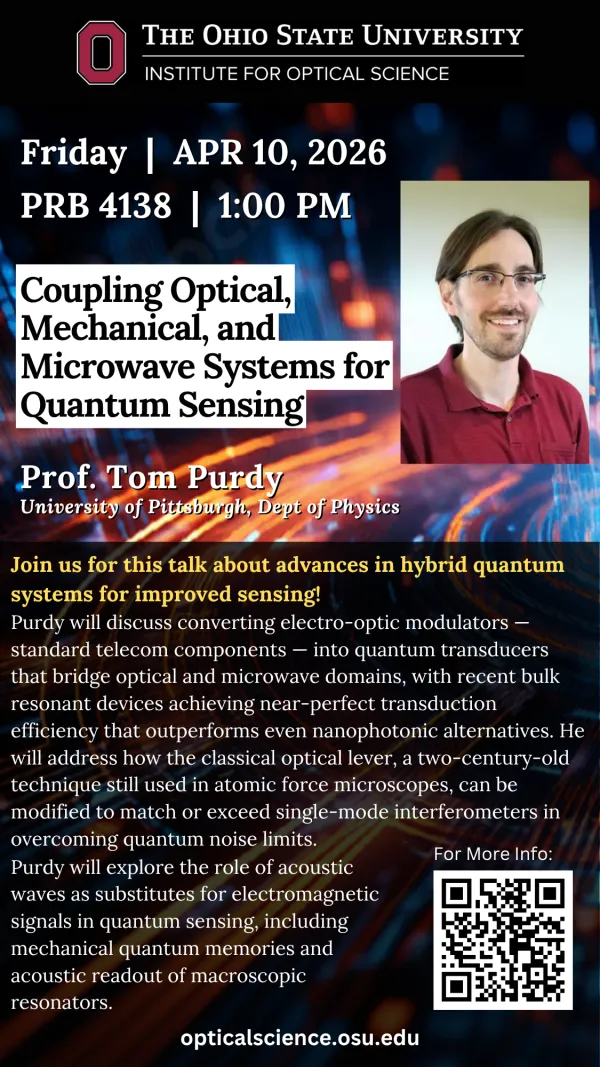
Coupling Optical, Mechanical, and Microwave Systems for Quantum Sensing
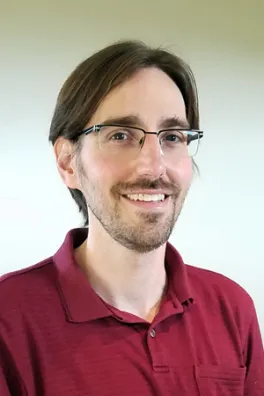
Professor Tom Purdy
Department of Physics & Astronomy, University of Pittsburgh
Time: Friday, April 10th 2026 at 1:00PM
Location: Physics Research Building 4138, Zoom
Join Zoom Here
ABSTRACT: I will present recent experiments that push the limits of hybrid quantum systems in a quest to make better sensors. First, we consider how it might be possible to turn an electro-optic modulator, a workhorse of modern classical telecommunications systems for encoding microwave signals on laser light, into a transducer capable of efficiently moving quantum information between the optical and microwave domains. Our recent results show that bulk, resonant electro-optic devices are capable of near unit transduction efficiency, surpassing even the best nanophotonic devices on this metric. We are currently exploring how laser light in this system can be used to manipulate and measure microwave devices in an analogy to laser cooling in atomic and optomechanical systems. Next, I will explain how the optical lever (one of the oldest and most technically simple precision measurement techniques, with roots in the scientific literature stretching back two centuries and still the go-to readout for modern atomic force microscopes) can be pushed to and beyond standard quantum limits. Despite its simplicity, a few minor modifications to the optical beam path allow optical lever detection to match or even surpass traditional single-mode interferometers in terms of quantum noise and its evasion. If time allows, I will also touch on the unexpected places where acoustic waves can replace their electromagnetic counterparts in quantum sensing: mechanical quantum memories, the acoustic analog of blackbody radiation, and acoustic readout of macroscopic mechanical resonators.
BIO: Dr. Purdy is interested in harnessing the quantum effects intrinsic in the mechanical interaction of light with macroscopic mechanical resonators to improve measurement and metrology. Previously, Dr. Purdy worked as a physicist in the Quantum Optics Group, Quantum Measurement Division, PML at NIST. Before joining NIST, Dr. Purdy has worked on a wide variety of optomechanical systems as a postdoctoral researcher at JILA and in his graduate work at UC Berkeley.
Join Zoom Here
- No Registration Needed - Refreshments will be provided - This event is open to the public -
What is the Institute for Optical Science?
The Institute for Optical Science is a community of multidisciplinary researchers studying the fundamental properties of light and harnessing these properties in practical applications for significant benefit to society.